
Good Holistic Health: A Guide to Whole-Person Well-being
In a world where health advice often feels like a series of loud commands, it is easy to feel more overwhelmed than helped. We are frequently told to 'fix' ourselves with quick solutions or 'change' our lives with the latest trend.
Good holistic health is a different kind of conversation. It is a quieter, more grounded approach that looks at you as a whole person rather than a collection of symptoms to be solved.
At Norma Shiatsu Croydon, we see health as a form of stewardship. It is the steady, ongoing practice of looking after your physical, mental, and emotional space so that you can move through the world with more ease.
Key Takeaways
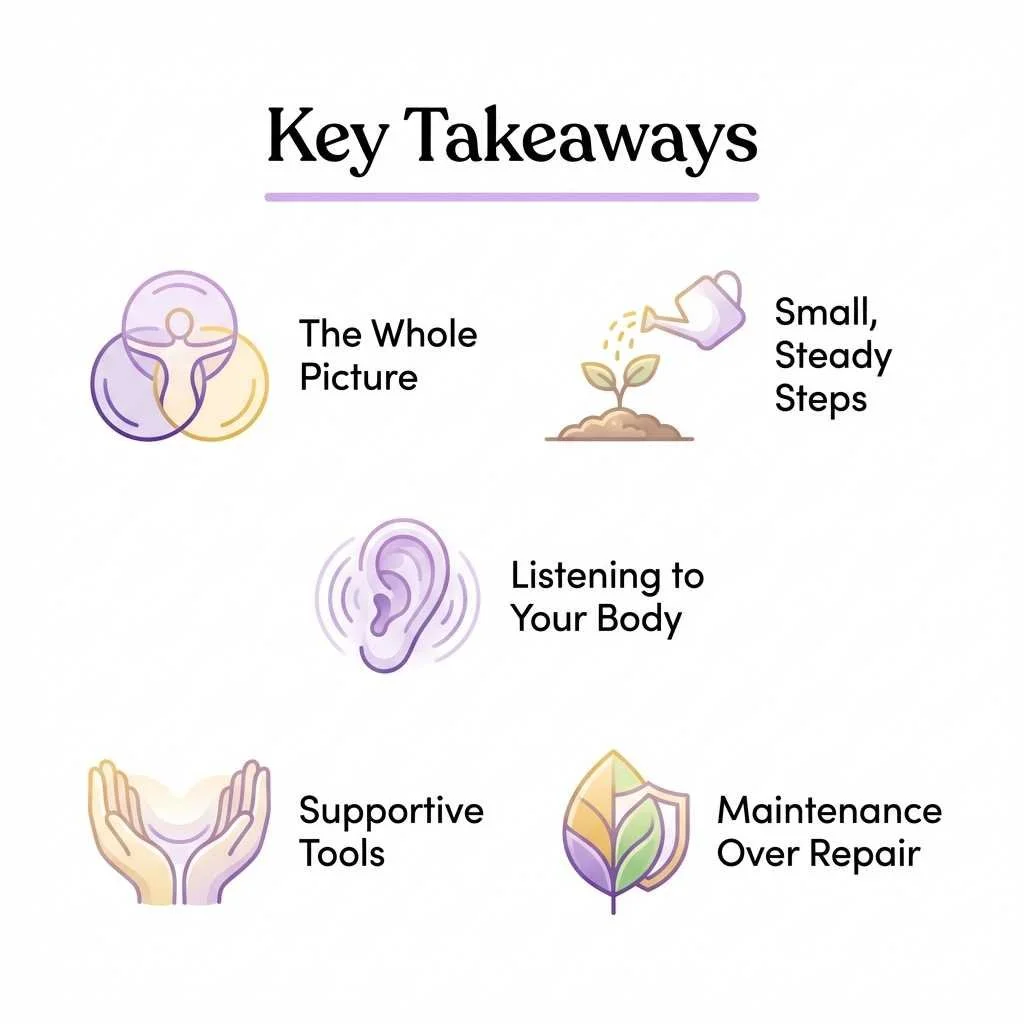
The Whole Picture: Good holistic health acts as a unified system where body, mind, and environment lean on each other, rather than working in isolation.
Small, Steady Steps: True wellbeing is built through consistent, daily actions—much like tending a garden—rather than looking for one-time 'cures.'
Listening to Your Body: Learning to notice small signals early, like tension or fatigue, helps you find balance before a 'storm' of exhaustion hits.
Supportive Tools: Practices like Shiatsu are not magical 'fixes' but are quiet tools that provide the necessary space to rest and reset your nervous system.
Maintenance Over Repair: Just as you service a car to keep it running, holistic practices work best as preventative maintenance, not just emergency repair.
Understanding Good Holistic Health
When we talk about good holistic health, we are moving away from the idea that health is simply the absence of illness. It is more than just not having a cold or a backache today.
Holistic health comes from the word 'holos,' which means whole. It is an acknowledgment that your physical sensations are often linked to your thoughts, your stress levels, and even your social connections.
If you have ever had a 'heavy' feeling in your shoulders after a difficult week at work, you have already experienced how these things are connected. A holistic approach doesn't just look at the shoulders; it looks at the week you have had.
It invites us to ask questions like: How are you sleeping? How are you digesting your food—and your experiences? Do you feel safe in your environment?
This is not about being intrusive. It is about recognizing that every part of you affects every other part. When one string on an instrument is out of tune, the whole chord sounds different.
What are Holistic Health Practices?
People often ask, "what are holistic health practices?" and expect a list of complicated rules or expensive supplements. In reality, the most effective practices are often the ones that feel most natural and sustainable.
Think of your wellbeing like a tidy room. When the room is cluttered with old items, dust, and things out of place, it is hard to find what you need. You cannot move freely. You might trip over things.
Holistic health practices are the small habits that help you 'tidy' your internal space. They clear the pathways so your energy can flow without obstruction.
These practices might include how you nourish yourself, how much you move, and how you choose to rest. They are not about perfection. They are about making it easier for your body to do its job.
When you drink water, you are flushing the system. When you stretch, you are opening a door. When you rest, you are letting the dust settle.
The Five Pillars of Balance
To help make sense of this broad concept, we often look at five different areas of life. No single pillar is more important than the others; they all support the structure of your wellbeing.
1. The Physical Pillar
This is the most direct part of our wellbeing. It involves the basic maintenance of the body—drinking enough water, eating foods that provide steady energy, and finding gentle ways to move.
It is helpful to think of the physical body like a car. You don't wait for the engine to smoke before checking the oil. Best holistic health practices involve this kind of regular, quiet maintenance.
For many, this includes bodywork. Whether you are looking for Japanese Massage in London or a simple stretching routine, the goal is to keep the "machinery" of your body moving smoothly.
2. The Mental Pillar
Our mental health is about how we process information and manage our thoughts. In a fast-paced world, this often means finding ways to slow down the 'noise.'
Scientific research suggests that our brains process a staggering amount of data daily. Without a break, this leads to cognitive fatigue.
Practising stillness, even for five minutes a day, can help clear the mental 'clutter.' It allows you to approach your day with more clarity and less reactivity. It is not about stopping your thoughts, but about not letting them drive the bus all the time.
3. The Emotional Pillar
Emotional wellbeing is the ability to be honest with ourselves about how we feel. It is not about being happy all the time; it is about having the resilience to navigate the highs and lows.
When we acknowledge our feelings without trying to 'fix' them immediately, we create a sense of internal space. This is a vital part of good holistic health.
We often see clients who hold emotional weight in their physical frame—tight jaws or rigid necks. Acknowledging the emotion often helps the muscle let go.
4. The Social Pillar
We are not meant to live in isolation. Our relationships and our sense of belonging to a community have a direct impact on how well we feel.
Taking time for a quiet conversation or a shared walk can be just as important for your health as your diet or your exercise routine.
Even a brief, kind interaction with a neighbour or a holistic practitioner in Croydon can signal to your nervous system that you are safe and connected.
5. The Spiritual Pillar
This does not have to be about religion, though it can be. It is more about having a sense of purpose and meaning. It is the 'why' that keeps us grounded when life feels uncertain.
For some, this is found in nature. For others, it is in art, or service to others. It is the anchor that holds the boat steady when the waves get high.
Why We Focus on Stewardship
At our practice in Croydon, we don't see ourselves as 'fixers.' We believe that you are the best steward of your own body. We are simply here to walk beside you for a while.
Good holistic health requires a sense of responsibility. It is the understanding that while we can provide a supportive environment, the steady work of wellbeing happens in your daily choices.
This might sound like a lot of work, but it is actually quite freeing. It means you don't have to wait for someone else to 'save' you. You can start making small, grounding changes today.
Stewardship means you treat your body with the same care you would offer a guest in your home. You offer it rest. You feed it well. You listen when it says it is tired.
The Best Holistic Health Practices for Daily Life
If you are looking for a place to start, we suggest focusing on these grounded practices. They don't require expensive equipment or dramatic life changes. They simply ask for your attention.
Restorative Sleep
Sleep is the time when your body does its most important 'tidying.' Physiological studies show that during sleep, the brain actively clears out metabolic waste products.
Creating a simple, tech-free routine before bed can help signal to your system that it is safe to settle. This might mean dimming the lights an hour early or reading physical pages instead of a screen.
Conscious Breathing
You don't need a special class to breathe. Simply noticing your breath for a few moments several times a day can help calm your nervous system.
It acts like a weather warning; it tells your body the storm has passed. Deep, slow breaths stimulate the vagus nerve, which helps switch your body from "fight or flight" to "rest and digest."
Mindful Movement
Movement doesn't have to be intense to be effective. A slow walk in a park or some gentle stretching can help clear the 'leaves' from your path, making it easier to move forward.
The goal is to move the fluid in your joints and warm the muscles, not to punish the body. Gentle movement reminds the body that it is capable and fluid.
The Role of Professional Support
While self-stewardship is key, sometimes we need a little help to find our feet again. This is where professional therapies serve as excellent holistic health practices.
Shiatsu Massage
Shiatsu is a form of Japanese bodywork that uses gentle pressure and stretches to help the body find its own sense of balance. It works with the body's fascia—the connective tissue that holds everything together.
Stress can cause this tissue to become sticky and stiff. Shiatsu helps to 'iron out' these crinkles, restoring smooth movement. It is a 'quiet hour' where you don't have to explain anything. You simply get to be present.
Japanese Facials
Many people hold tension in their face without realizing it. A Japanese facial in London is not just about skin deep beauty. It addresses the deep muscles of the face, neck, and head.
Releasing tension here can have a ripple effect, easing headaches and calming the mind. It is a profound way to care for the part of you that faces the world every day.
Reiki Therapy
For those seeking a more subtle approach, Reiki in Croydon offers a gentle way to restore energy balance. It is a non-invasive practice that encourages deep relaxation.
It is particularly helpful for those who feel "scattered" or mentally exhausted. It provides a container of stillness where your system can reorganize itself.
Combined Treatments
Sometimes, the body needs a combination of approaches. We offer Shiatsu Massage and Reiki combined in Croydon for a truly immersive experience.
This combination allows for the structural release of Shiatsu alongside the energetic settling of Reiki. It is a deep-dive into rest for those who have been running on empty for too long.
Holistic Health for Your Work
We often forget that we bring our bodies to work. The stress of emails, deadlines, and meetings accumulates in our physical frame.
We offer services for business teams because a healthy team is a steady team. Introducing holistic practices into the workplace says, "We value you as a whole person."
It is not about squeezing more productivity out of people. It is about ensuring everyone has the energy to show up fully. When the team is balanced, the work flows more easily.
Realistic Expectations on the Path to Health
It is important to be honest: change takes time. You didn't get tired or out of balance overnight, and you won't feel fully restored after one session or one good meal.
Good holistic health is a slow conversation with yourself. Some days you will feel more balanced than others, and that is perfectly okay. The goal is not a perfect state of health, but a more resilient way of living.
We avoid words like 'transformation' because they imply that who you are right now isn't enough. You don't need to be transformed; you just need the space to settle and breathe.
If you are looking for more insights on this steady path, our Shiatsu Blog explores these themes regularly.
Common Questions About Holistic Health
Is this a replacement for my doctor? No. We believe in a collaborative approach. Conventional medicine is vital for diagnosing and treating acute conditions. Holistic health practices are a way to support your overall vitality and maintain your "engine" alongside any medical care you receive.
How often should I use these practices? Think of it like a car service. You don't just do it once and forget it. Small, daily habits (like checking the oil) are the most effective. Supportive therapies like Shiatsu are best used as a regular 'check-in' for your system—perhaps once a month—to prevent breakdowns.
What if I don't feel anything during a session? That is quite common. Sometimes the most profound changes are the quietest. You might simply feel a bit more grounded or have a better night's sleep three days later. These are all signs of your body finding its way back to balance.
Can these practices help with workplace stress? Absolutely. Workplace stress often puts the nervous system in a chronic state of "alert." Holistic practices help manually switch the system back to "calm," allowing you to recover from the work week rather than just enduring it.
An Invitation to Pause
If you feel that your life has become a bit too loud or cluttered, perhaps it is time for a pause. Good holistic health is always available to you; it just requires a little bit of time and attention.
Whether you choose to start with a short walk, a glass of water, or a quiet hour on a treatment mat, the first step is simply noticing that you deserve that space.
If you would like to explore how Shiatsu can support your own path to wellbeing, you are welcome to look at our current availability. We offer a calm, grounded space in Croydon for those who are ready to listen to what their body has to say.
There is no rush. We are here when you are ready.
About the Author
This article was brought to you by Norma Powell, a dedicated Shiatsu practitioner at Norma Shiatsu Croydon. With a warm and steady approach, Norma provides nurturing Shiatsu treatments designed to ease physical tension and promote overall relaxation. Her practice is rooted in empathy and a genuine commitment to helping people feel safe and comfortable in their own bodies, focusing on the tangible, restorative benefits of touch-based therapy.
Connect with Norma on LinkedIn
Sources
Autonomic Nervous System Operations. Scientific American. (2019)
The Role of Fascia in Stress Response. Journal of Bodywork and Movement Therapies. (2021)
Sleep and Brain Clearance. University of Rochester Medical Center. (2013)
