
What is a Holistic Health Home? A Grounded Guide to Whole-Person Wellness
In a world that often feels hurried and demanding, many of us reach a point where we feel slightly out of sync. It isn’t always a specific illness that we can name. Instead, it might be a quiet sense of depletion, a mind that won’t settle, or a body that feels heavy with the day’s tensions.
You may have looked for answers in many places, only to be told that everything looks ‘fine’ on paper. Yet, your own experience tells you that you aren't quite your usual self. This is often the starting point for building a holistic health home.
This concept isn’t about a one-time fix or a dramatic transformation. It is about creating a steady, supportive environment—both inside your body and within your living space—where wellbeing can naturally settle and grow over time.
Key Takeaways
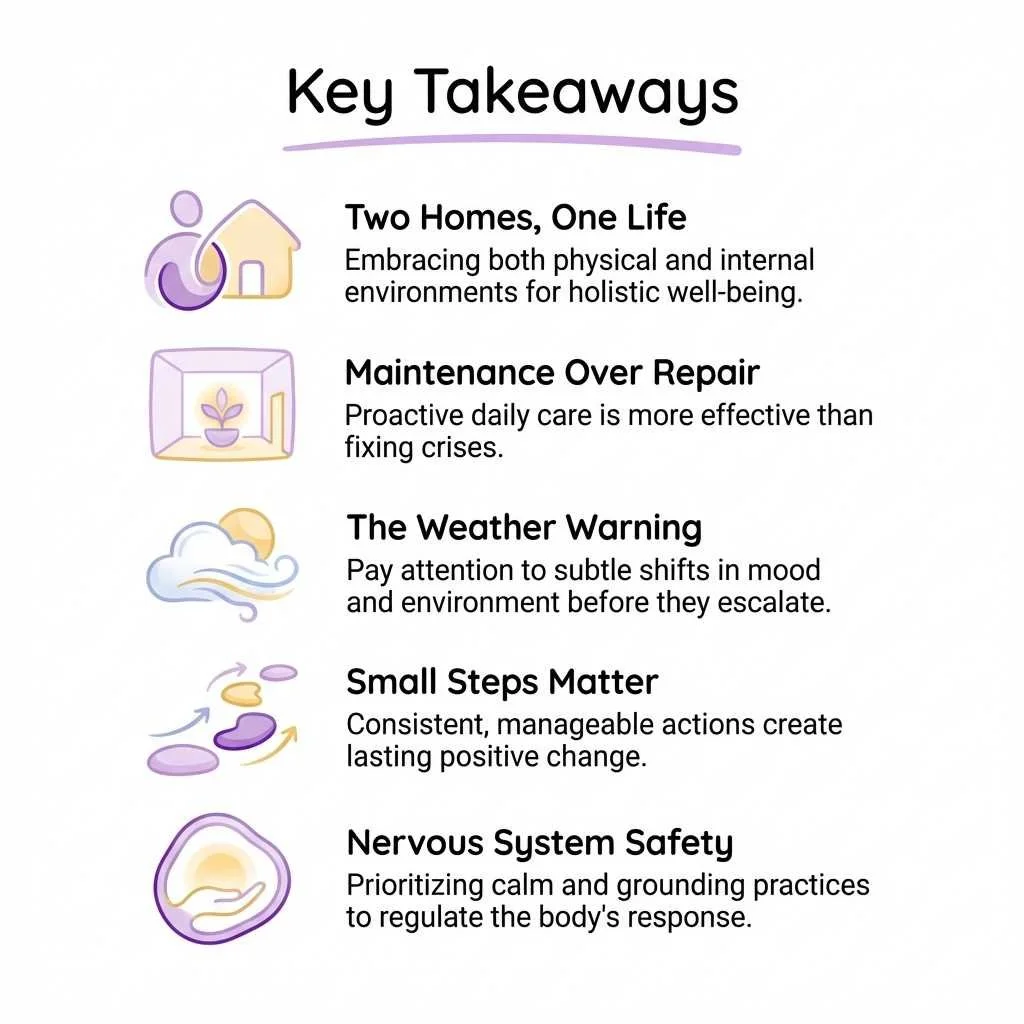
Two Homes, One Life: We live in two homes simultaneously: our physical body and our living space. Both need stewardship.
Maintenance Over Repair: It is far easier to maintain a tidy room than to clean a hoard. Wellbeing works the same way.
The Weather Warning: Learning to spot the early signs of stress (the wind) before the burnout (the storm) hits.
Tools, Not Magic: Therapies like Shiatsu and Reiki represent honest labour and support, not instant miracle cures.
Small Steps Matter: A holistic approach is built on small, quiet choices made every day, not grand gestures.
Nervous System Safety: Your environment sends constant signals to your brain. We want those signals to say "safe."
Defining the Concept: What is it?
When we speak about this idea, it can sound abstract. But it is actually very grounded. To understand it, we simply need to look at the word 'holistic.'
This word comes from 'whole.' It means we do not slice you up into separate parts. We do not look at a sore shoulder as just a muscle problem. We do not look at anxiety as just a brain problem.
We look at the whole person. We see how your shoulder tension might be connected to your work stress. We see how your anxiety might be connected to how you breathe.
Building a holistic health home implies two things. First, it means treating your body with the same care you would give to a beloved family home. Second, it means arranging your life so that health is a natural result of your daily routine, not a chore you have to force.
The First House: Your Internal Environment
We often forget that our body is the only house we have to live in for our entire lives. We cannot move out. We cannot trade it in.
If you owned a physical house, you would likely have a plan for maintenance. You would clear the gutters. You would fix a leaking tap before it flooded the kitchen. You would paint the walls to keep them fresh.
Yet, with our bodies, we often wait until something breaks. We ignore the 'creaking floorboards' of our knees. We ignore the 'flickering lights' of our headaches.
The Stewardship Mindset
We prefer the word 'stewardship' over 'health hacks.' A steward is someone who looks after something precious. When you act as a steward for your holistic health house, you adopt a mindset of gentle observation.
You ask simple questions. Is this structure sound? Am I overloading the foundations? Do I need to open a window and let some fresh air in?
This is where the guidance of a trusted holistic practitioner in Croydon can be valuable. Sometimes, we are too close to our own 'house' to see the cracks. An outside eye can help us spot where the maintenance is needed most.
The Second House: Your Physical Space
Your nervous system is always watching. It scans your environment every second of the day, asking one question: Am I safe?
If your physical home is cluttered, loud, or chaotic, your nervous system stays on high alert. It keeps your stress hormones running. It keeps your muscles tight. It is bracing for trouble.
Creating holistic health at home involves signaling safety to your body. This doesn't mean you need expensive furniture. It means creating a space that feels manageable.
It is about the sensory inputs. Soft lighting in the evening tells your brain to produce melatonin for sleep. A clear table tells your mind that there is space to think. These are not just decoration choices; they are health choices.
The Tidy Room Analogy
Think of your wellbeing like a room that has become cluttered over the years. We all have that one room. Maybe piles of paper have built up. Maybe clothes are on a chair.
When the room is messy, everything is harder. You trip over things. You can’t find what you need. You feel tired just looking at it.
Many health approaches try to "gut renovate" the room in one day. They demand you change your diet, your exercise, and your sleep all at once. This usually fails. It is too much change, too fast.
Our approach is different. We believe in the slow tidy. You pick up one sock. You stack one pile of papers. You open one window.
Slowly, the room becomes breathable again. You can move freely. This is the goal of our work. We want to help you clear the clutter within your body so you can move through your life with ease.
The Three Pillars of a Sturdy House
A house needs strong pillars to stand up against the weather. In our philosophy, these pillars are the Body, the Mind, and the Spirit. If one pillar cracks, the roof starts to sag. The other pillars have to take on too much weight.
1. The Body: The Brick and Mortar
This is the tangible structure. It includes your muscles, your bones, and your fluids. Maintenance here is practical.
Hydration: Think of water as the oil for your engine. Without it, things grind together.
Movement: Joints have no blood supply of their own. They rely on movement to get nutrients. If you don't move a hinge, it rusts.
Rest: Sleep is when the repair crew comes in. If you cut sleep short, the repairs are never finished.
When the physical structure feels tight or misaligned, therapies like Japanese Massage in London can help verify where the tension is holding on.
2. The Mind: The Electrical Wiring
Your thoughts are the electrical signals running through the house. If the voltage is too high—if you are constantly worrying or rushing—you can blow a fuse.
A mind that is constantly 'on' creates a body that is constantly tense. You might notice your shoulders are up by your ears, or your jaw is clenched. This is your body trying to contain the energy of your mind.
Maintenance here involves 'powering down.' It means finding moments where you do not need to process information. It is about staring out of a window instead of at a screen.
3. The Spirit: The Light in the Windows
This is perhaps the hardest to define, but you know it when you feel it. It is your vitality. It is the difference between a house that looks lived-in and warm, and a house that looks cold and empty.
When the spirit is depleted, we feel a deep fatigue that sleep doesn't fix. We feel flat. We feel like we are just going through the motions. Restoring this pillar often requires quiet, stillness, and a safe space to just 'be.'
The Garden Path: Managing the External
Let’s look at how to practically implement holistic health at home. You do not need to buy special gadgets. You mostly need to subtract things that are causing noise.
The Lighting Diet Our bodies run on circadian rhythms. We are designed to rise with the sun and slow down with the sunset. Modern life disrupts this. We sit under bright LEDs until midnight. This confuses our internal clock. Try turning off overhead lights after 8:00 PM. Use lamps. Use candles. This simple shift signals to your body that the day is done.
The Noise Diet Silence is a nutrient. We rarely get enough of it. Try to drive without the radio on. Try to wash the dishes without a podcast playing. Give your mind a chance to digest the day. This creates 'white space' in your brain, preventing the feeling of overwhelm.
The Texture of Life We are tactile creatures. We need touch. Yet, we spend all day touching smooth, cold glass screens. Introduce natural textures to your home. Wood, wool, cotton, plants. These grounding textures help us feel more connected to the physical world.
Supportive Tools for Your Journey
While the daily work of stewardship belongs to you, you do not have to do it alone. There are times when the 'house' needs a professional service.
At Norma Shiatsu Croydon, we offer specific tools to help you maintain your structure. We are honest about what these tools do. They are not magic wands. They are maintenance practices.
Shiatsu: The Structural Survey
Shiatsu is a Japanese therapy that works with the body's energy lines and physical structure. You can think of it like a car service, or a structural survey for your house.
During a session, you remain fully clothed. We use finger pressure, palm pressure, and gentle stretches.
It is a very grounding experience. It helps you find the floor. It helps you locate where you are holding onto stress.
Many people walk in feeling like their head is floating somewhere above their body. Shiatsu helps bring the two back together. If you want to read more about the philosophy behind this, our Shiatsu Blog explores these ideas in depth.
Reiki: Clearing the Dust
Sometimes, the clutter isn't physical. It offers an energetic weight. You might feel heavy, sad, or just 'off.'
Reiki in Croydon provides a different kind of support. It is very still. It is very quiet. The practitioner works to balance the energy flow of the body.
If Shiatsu is the structural repair, Reiki is like opening all the windows on a spring day to let the stale air out. It encourages a deep state of rest where your own natural healing ability can switch on.
The Combination: Deep Maintenance
Some days, you need both structure and stillness. We offer sessions that blend these two modalities.
Shiatsu Massage and Reiki combined in Croydon allows us to address the physical tension in your muscles while also tending to the tired mind. It is a comprehensive 'service' for the whole person.
Holistic Facials: The Exterior Reflection
We often ignore our faces until we see a wrinkle. But the face is a map of what is happening inside. Stress locks into the jaw. Exhaustion shows under the eyes.
A Japanese facial in London is not just about beauty. It is about health. We use massage techniques to release tension in the face, neck, and head. This increases circulation and helps the skin look alive again. It is a way of honoring the face you present to the world.
The Practice of Honest Labour
We must be realistic. There is no shortcut to long-term health. You cannot buy a pill that replaces a good night's sleep. You cannot pay someone to fix a bad diet for you.
Wellbeing is honest labour. It is the daily practice of making small choices that favor your health.
It acts like compound interest. One glass of water doesn't change much. But drinking water properly for a year changes everything. One early night doesn't fix burnout. But prioritizing rest for a month builds a new foundation.
Our role is to support you in this labour. We provide a space where you can stop. We provide a space where you are not required to do, but are allowed to simply be.
Listening to the Weather Warning
Living in a holistic health house means becoming a weather watcher.
Stress does not appear out of nowhere. It builds up like a storm front.
First, the wind picks up (you feel irritable).
Then, the clouds darken (your sleep gets patchy).
Then, the rain starts (your neck feels stiff).
Finally, the storm hits (you get sick or burnout).
If you can learn to notice the wind, you can close the shutters early. You can take a warm bath. You can book a treatment. You can say 'no' to that extra commitment.
Common Questions (FAQ)
Is this the same as seeing a doctor? No. We work effectively alongside traditional medicine, but we are different. A doctor diagnoses and treats illness. We support general wellbeing and lifestyle balance. If you have checking symptoms or medical concerns, you must always speak with a doctor first.
How many sessions will I need to feel better? Because everyone's 'internal home' is unique, there is no set number. Some people use a monthly session as their regular maintenance check-in. Others come weekly during high-stress periods. We treat it as an ongoing practice, not a destination.
What is the difference between massage and Shiatsu? Standard massage often uses oil and glides over muscles. Shiatsu is performed through clothing and uses vertical pressure on specific points. It feels more 'focused' and rhythmic. It often leaves you feeling grounded and alert rather than just sleepy.
I have a very busy life. Can I still do this? Yes. In fact, busy people need this the most. Holistic health isn't about adding 20 hours of meditation to your week. It’s about how you approach what you already do. It is about breathing while you commute. It is about eating lunch away from your desk.
Do I need any special equipment to have a holistic health home? Not at all. The most important 'equipment' is your awareness. High-quality basics—like decent food, fresh air, and a quiet place to sit—are far more valuable than expensive gadgets or supplements.
An Invitation to Take a Pause
Building a holistic health home is a journey that requires patience and grace. It is about moving away from the pressure to be 'perfect' and moving towards a life that feels more sustainable and honest.
If you feel that your 'internal home' is a little cluttered or you simply need a quiet space to find your feet again, we are here to walk beside you.
We offer a grounded, simple approach to wellbeing through Shiatsu, Reiki, and holistic care. There is no rush, and there is no pressure. When you feel ready for a pause, you can see our current availability here.
Take a deep breath. The path to feeling more like yourself is right in front of you, one small step at a time.
Sources
Frontiers in Psychology. (2025). Effects of restorative environments on mental health and its cognitive neural mechanisms. Available at: Frontiersin.org
