
What is Holistic Healthcare Approach? Unpacking Whole-Person Wellness
In our busy lives, many of us reach a point where we feel 'not quite right'. It might be a persistent heaviness in the shoulders. It might be a mind that won't stop racing at night. Or, it could be a sense of fatigue that a bank holiday weekend doesn't seem to touch.
Often, when we seek help, we are looked at in parts. A specialist might look at our digestion. Another looks at our skin. A third looks at our sleep. While this focus is important, we can sometimes feel like the person behind the symptoms has been forgotten. This fragmentation is why many people begin to ask: what is holistic healthcare approach?
At its simplest, this approach is about looking at the whole picture. It is the understanding that your physical body, your thoughts, your emotions, and even your social connections are all part of one single system. They are interconnected. When you pull on one thread, the whole fabric moves.
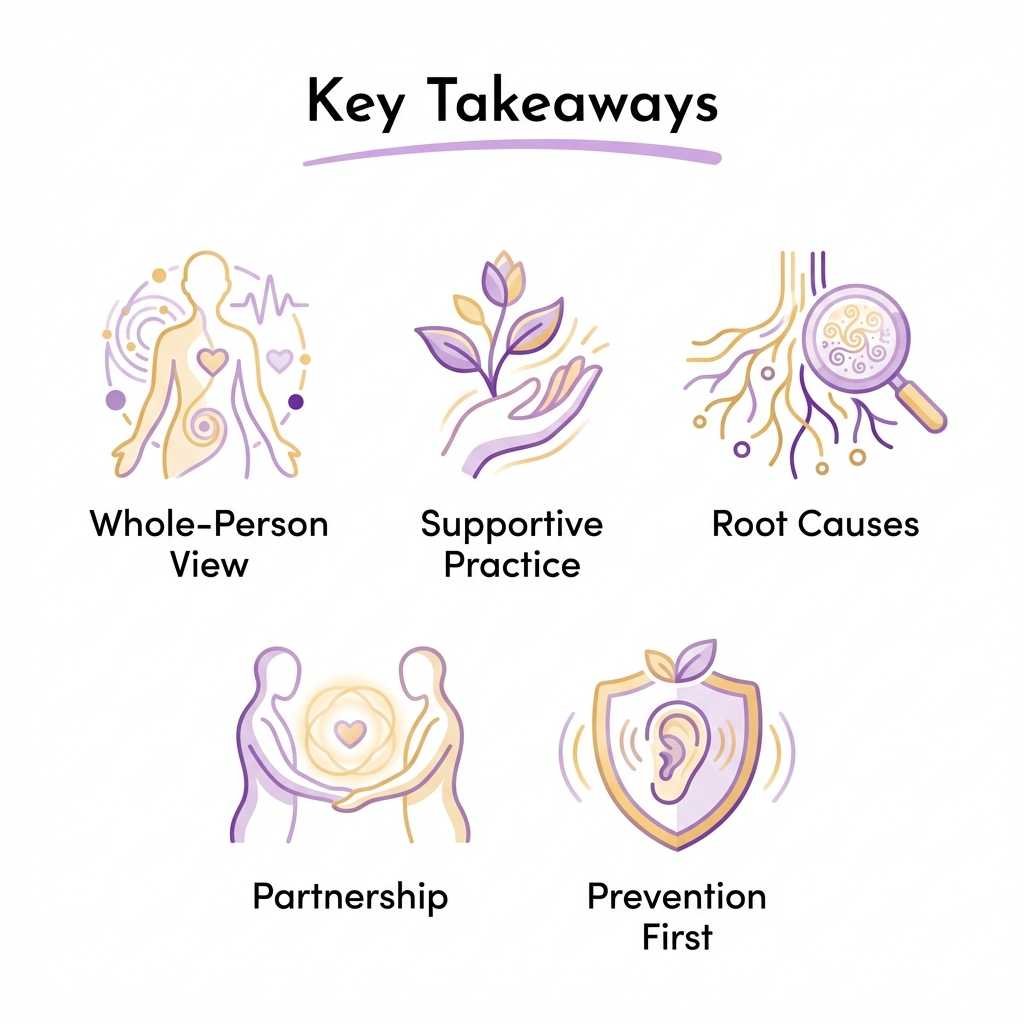
Key Takeaways
Whole-Person View: We treat the person as a whole entity, not just a collection of separate symptoms.
Supportive Practice: Wellbeing is an ongoing practice, much like tending a garden, rather than a one-time fix.
Root Causes: We aim to understand why a tension exists. This helps you find a sense of balance over time.
Partnership: You are the steward of your own body. As a holistic practitioner in Croydon, my role is simply to offer a quiet space for support.
Prevention First: We listen to the body's "whispers" before they become "shouts."
Scientific Backing: Modern health organizations now recognize that social and emotional factors are vital to physical health.
Understanding the Basics: What is Holistic Healthcare Approach?
To understand what is holistic healthcare approach, it helps to think of a room that has become cluttered. Imagine a living room filled with items out of place.
If you only clean one small corner, the rest of the room still feels uncomfortable. You might have a tidy desk, but if the floor is covered in boxes, you still cannot walk freely. To truly feel at ease, you have to look at the whole space.
The specific phrase what is holistic healthcare approach refers to a method of care that considers the complete human experience. We do not just look at the 'broken part'. We look at the environment that the part lives in.
The Problem with Fragmentation
In the West, we often view the body like a machine. If the 'pump' (heart) has an issue, we see a mechanic for the pump. If the 'wiring' (nerves) acts up, we see an electrician.
This method is brilliant for acute emergencies. If you break a leg, you need a specialist to set the bone. However, for long-term wellbeing and chronic unease, this mechanical view falls short. It ignores the driver of the car. It ignores the weather conditions.
Measurements and tests are useful. But they rarely capture how tired you feel after a meeting with your boss. They don't measure the grief you carry from a loss years ago. A holistic approach makes room for these invisible factors.
The Five Pillars of a Holistic Health Approach
When we discuss a holistic health approach, we are usually looking at five main areas of life. These are often called the 'pillars' of health.
1. Physical State
This is the vessel you live in. It involves your muscles, your digestion, your sleep, and your energy levels. Physical symptoms are often the final signal that something is out of balance elsewhere. A tight neck might not just be from a bad pillow. It might be the physical weight of unspoken stress.
2. Mental Clarity
This covers how you process information. Are you constantly distracted? Is your mind foggy? Mental health is not just about the absence of illness. It is about the presence of clarity. It is the ability to focus on one thing at a time without feeling overwhelmed.
3. Emotional Balance
Emotions are weather. They pass through us. In a balanced state, we feel emotions, but we are not drowned by them. When we suppress emotions—like anger or sadness—they often manifest as physical tension. We store our worries in our tissues.
4. Social Connection
Humans are herd animals. We need connection to feel safe. Isolation is a major stressor for the body. A holistic approach asks about your relationships. Do you feel supported? Do you have a community? This "social determinant of health" is as vital as your diet.
5. Sense of Purpose (Spirit)
This does not necessarily mean religion. It means having a reason to get up in the morning. It is a sense of belonging to something larger than your immediate worries. When we lack purpose, we often feel a deep, unshakable type of fatigue.
When one of these areas is out of balance, it naturally affects the others. For example, chronic stress at work (mental) creates cortisol spikes. This leads to inflammation (physical). This might make you irritable, straining your marriage (social). By looking at the whole person, we can begin to see how these threads are woven together.
The Difference Between 'Fixing' and Supporting
In many traditional settings, the goal is to 'fix' a problem once it has already happened. This is a bit like waiting for a car to break down on the motorway before taking it to a garage. It is reactive. It is stressful. It is often expensive.
What is holistic healthcare approach in comparison? It is more like a regular car service. It is about maintenance. It is about listening to the small noises the engine makes before they become major faults.
We don't use words like 'cure' or 'fix'. These words imply you are broken. You are not broken. You are simply navigating a complex world.
Instead, we talk about finding a sense of balance. We believe that your body has its own quiet wisdom. It knows how to heal cuts and mend bones. Our role is to provide the time and space for you to listen to that wisdom. We remove the obstacles—the stress, the tension—so your body can do what it does best.
The NSC View: Wellness as a Practice
At Norma Shiatsu Croydon (NSC), we often remind those who visit us that feeling well is not a destination. You don't 'arrive' at health and stay there forever. Instead, it is a practice. It is a verb, not a noun.
Think of it like a garden path. Over time, leaves and debris will naturally fall and cover the stones. This is normal. It is not a failure of the garden. But if you leave them there, the path becomes difficult to walk on.
Ongoing wellbeing involves gently clearing those leaves away every so often. This keeps the way forward clear.
This requires small, consistent actions. It implies stewardship.
It might be choosing to breathe more deeply during a commute.
It might be adjusting how you sit at your desk to respect your spine.
It might be booking a regular session to reset your baseline.
This is why we consider ourselves a Japanese Massage in London provider with a difference. We are not here to verify that you are ill. We are here to support your wish to remain well.
How Shiatsu and Reiki Fit Into This Approach
When people explore what is holistic healthcare approach, they often come across therapies like Shiatsu and Reiki. These are not 'magic' treatments. They are not shortcuts. They are grounded, physical tools that support the whole person.
Shiatsu: Finding a Sense of Balance
Shiatsu is a Japanese bodywork therapy. It translates to "finger pressure." It involves comfortable pressure on specific points of the body along energy pathways.
In a holistic framework, we don't just see this as 'massaging a muscle'. We see it as communication.
By applying pressure, we send a signal to your nervous system. We help the body move out of a 'fight or flight' state (sympathetic) and into a 'rest and digest' state (parasympathetic). This switch is crucial. Healing only happens in the 'rest' state.
This helps you notice where you are holding tension. You might realize your shoulders have been up by your ears all week. Awareness is the first step to release.
Reiki: A Quiet Pause
Reiki is a very gentle form of support. It provides a quiet hour where you can simply be. There is no demand on you. You do not need to talk. You do not need to perform.
In our noisy world, this mental pause is a vital part of a holistic health approach. It allows the 'clutter' of the mind to settle. It clears the static.
For those engaging with Reiki in Croydon, the experience is often described as a deep settling. It is like the feeling of finally sitting down after a long hike. It supports the emotional and spiritual pillars of health by offering deep rest.
Combining the Two
Sometimes, one approach isn't enough. The body is tight, and the mind is racing. In these cases, we often suggest Shiatsu Massage and Reiki combined in Croydon. This addresses the physical tension with Shiatsu and the energetic exhaustion with Reiki. It covers more of the holistic picture in a single session.
Japanese Facials: Not Just Skin Deep
We also offer a specific type of facial. A holistic facial isn't just about how the skin looks. It is about the tension we carry in our faces.
Think of the furrowed brow of concentration. Think of the tight jaw of held-back words. These are physical manifestations of emotional patterns.
Our Japanese facial in London focuses on softening these muscles. By relaxing the face, we send a powerful signal to the whole nervous system that it is safe to relax. It is beauty rooted in health, not just aesthetics.
Holistic Health for Teams: The Corporate Angle
Wellness isn't just for individuals. Groups of people—teams and businesses—have their own "health." A stressed team is like a body in pain. Communication breaks down. unexpected absences rise. The "energy" of the office feels heavy.
We extend our holistic health approach to local businesses. We offer support for teams who are feeling the strain of modern targets.
Providing space for staff to decompress is not a luxury. It is maintenance. Just as you service the company computers, you must support the people who operate them. A team that knows how to pause is a team that can sustain its effort for the long haul.
Why Prevention Matters
We often ignore the 'weather warnings' our bodies give us.
We notice we are a bit more irritable than usual.
We notice our sleep is becoming shallow.
We crave sugar or caffeine more than normal.
These are the winds picking up before a storm. They are the body whispering that balance is being lost.
Adopting a holistic healthcare approach means paying attention to these warnings. It means taking a step back when you feel the wind picking up. It implies acting before the storm hits.
This proactive way of living is the core of what is holistic healthcare approach. It is about avoiding the crash. It is about respecting your limits before you are forced to stop.
Realistic Evidence and Observations
We must be honest about what this approach can and cannot do. While every person's experience is different, many people find that a holistic approach leads to a change over time.
It is isn't an overnight transformation. It is rare to have a "miracle" moment. instead, it is a gradual shift. It is like turning a large ship.
You might find that after a few sessions of Shiatsu, you are reacting more calmly to stress at home. Or, perhaps you notice that your digestion feels more settled because you are taking more time to breathe. These are the 'grounded' results of looking at the whole person.
The Science is Catching Up
This is not just opinion. Scientific research increasingly supports this view.
The World Health Organization (WHO) defines health not merely as the absence of disease, but as a state of complete physical, mental, and social well-being. They have recognized this for decades.
Furthermore, the NHS is now placing more emphasis on 'Personalised Care'. This model recognizes that people’s health is determined by their social circumstances and their ability to control their lives. They acknowledge that things like social connection, nutrition, and stress management are just as important as clinical medicine for long-term health.
Research into the "Biopsychosocial Model" confirms that our biology (body), psychology (mind), and social factors (environment) constantly influence each other. Ignoring one part inevitably weakens the whole.
Common Questions (FAQ)
Does a holistic approach replace my doctor?
No. A holistic health approach works alongside conventional medicine. It is complementary. It is about adding another layer of support to your life. We always encourage you to speak with your GP about any medical concerns. We are here to support your wellness, not diagnose illness.
Is this 'woo-woo' or spiritual?
While some people find a spiritual connection in these practices, the way we work is very grounded. We focus on the physical sensation of the body. We focus on the rhythm of the breath. We focus on the quietness of the mind. It is about being more human, not less. It is about biology and nervous system regulation.
How many sessions will I need?
Because wellbeing is a practice, there is no set number. It is not a prescription. Some people find a monthly session helps them stay balanced. Others come more frequently during a particularly stressful time. It is a slow conversation with your own body. You decide the pace.
What if I don't know what's wrong?
That is perfectly fine. Many people come to us simply feeling 'off'. Part of the holistic healthcare approach is exploring that feeling together without the pressure to have an immediate answer. We provide the space for the answer to surface in its own time.
Practical Steps You Can Take Today
You don't need a professional session to start your own holistic health approach. You can start by being a better steward of your own energy today. Here is some "homework" for your wellbeing:
Listen to the 'Noise': Spend five minutes in silence. Do not check your phone. Just notice where your body feels tight or heavy. Acknowledge it without judging it.
Simplify Your Rest: Try to turn off screens an hour before bed. Give your mind a chance to 'tidy' itself before sleep. Blue light confuses the brain; darkness signals safety.
Move with Intention: Instead of a rushed workout, take a slow walk. Notice the sensation of your feet on the ground. Feel the air on your face. This grounds you in the present moment.
Breathe: When you feel rushed, take three slow breaths. Extend the exhale. This is a small, biological way of finding balance in the middle of a storm.
Read and Reflect: Education is part of the journey. Visit our Shiatsu Blog to read more about how others navigate these paths.
An Invitation to Pause
If you feel ready for a pause, we are here to walk beside you. We don't offer miracles. We don't offer quick fixes. But we do offer a quiet, respectful space where you can begin to listen to your body again.
What is holistic healthcare approach if not a return to our own steady, grounded selves? It is a path that leads away from the rush. It leads toward a more sustainable way of living.
If you would like to explore how Shiatsu or Reiki might support your ongoing wellbeing, you can see our current availability and learn more about our quiet space in Croydon. We invite you to begin the conversation with your own body.
Sources
World Health Organization (WHO). Constitution of the World Health Organization.
NHS England. Personalised Care.
National Center for Complementary and Integrative Health. Stress and Health.
About the Author
This article was brought to you by Norma Powell, a dedicated Shiatsu practitioner at Norma Shiatsu Croydon. With a warm and steady approach, Norma provides nurturing Shiatsu treatments designed to ease physical tension and promote overall relaxation. Her practice is rooted in empathy and a genuine commitment to helping people feel safe and comfortable in their own bodies, focusing on the tangible, restorative benefits of touch-based therapy.
